What is Wayang Kulit?
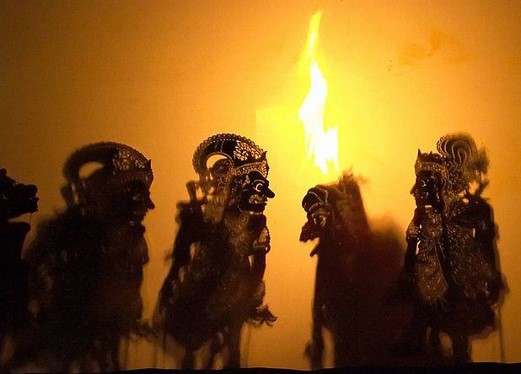
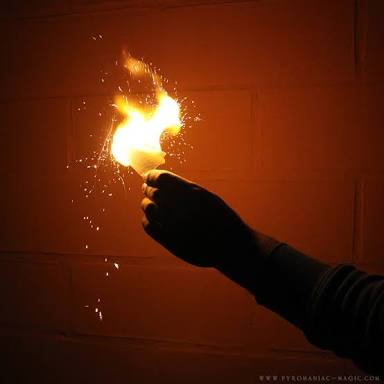
The word wayang refers to “shadows” while kulit translates to “leather”, the standard material of Balinese shadow puppets. So, Balinese shadow puppetry consists of leather puppets (wayang kulit) on sticks, a source of light (traditionally an oil lamp called blencong or damar), and a screen (kelir) on which the shadow is cast. Puppets not in use would be stuck into the gedebong, traditionally the trunk of a banana tree. The gamelan ensemble that usually accompanies a traditional wayang kulit performance is called the gamelan gender wayang.
The puppeteer, called the dalang, is a true master artist, playing the role of puppeteer, actor, dancer, musician, and conductor all at the same time. He also must have deep knowledge of the old Balinese and Hindu texts from which wayang stories are derived.
A traditional night-time performance of wayang kulit is customarily lit by a single oil lamp with the shadow cast on a white cloth screen. Audience members can watch from either side of the screen, either to see the shadows, or to watch the dalang, the all-important puppeteer, and his technique more closely.
Wayang Kulit Characters

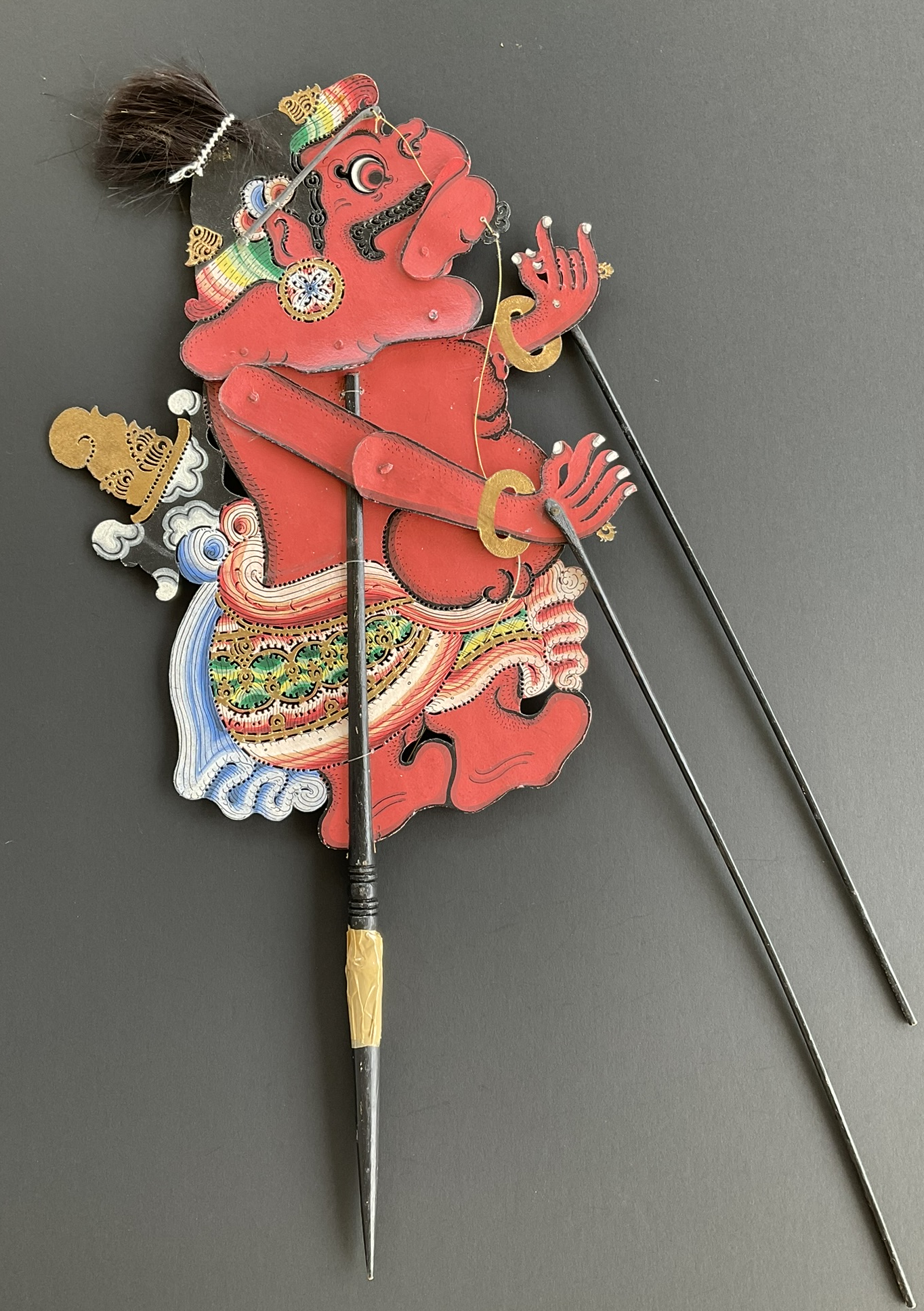
Delem
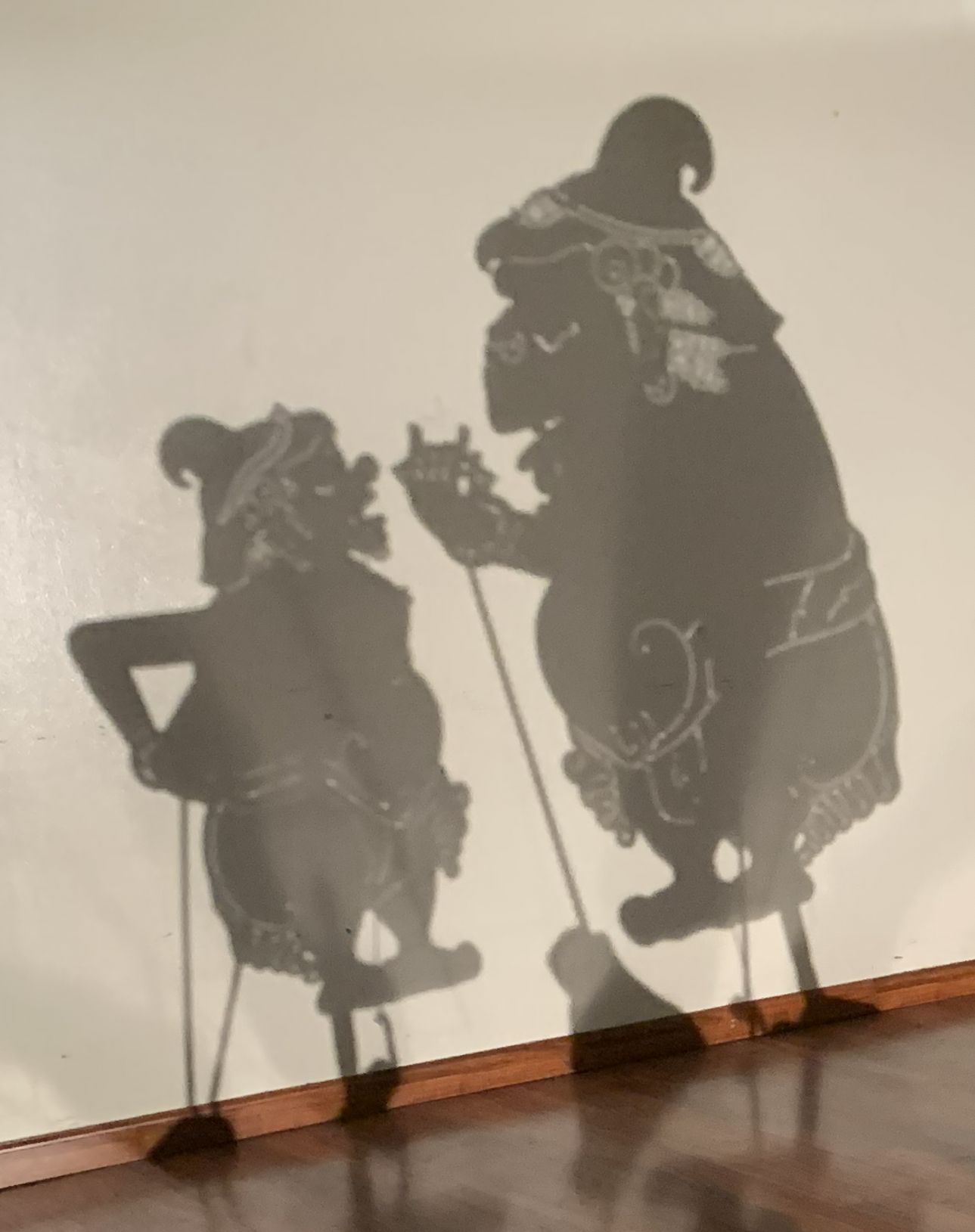
Merdah and Twalen
In Balinese wayang kulit, similar to other shadow puppet theatre in Southeast Asia, there are two major kinds of characters and, therefore, puppets: the “clown” puppets are narrators who typically assist the main characters, while the others are characters who are from the actual story itself, such as kings, angels, ogres, warriors, etc.
Character types can roughly be divided into strong (keras) and refined (alus). And then there are the clown characters, typically the narrators in Balinese performance, who are able to translate from the ancient literary language kawi (old Balinese/Javanese) to present-day Balinese, acting as a conduit between the world of the characters and that of the audience.
The four clown puppets whose names are Delem, Sangut, Merdah, and Twalen are revered puppets and are particularly spiritually potent. They also demonstrate the absence of the “fourth wall” in Balinese theatre: the puppets in a wayang kulit performance interact with the audience in the middle of the story being told. In fact, anachronisms are part of wayang kulit! Your students can practice switching between “narrator” puppet and “character” puppet voices. Refined character types such as gods and goddesses, ministers and knights, angels and mystical creatures make up another group of puppets. You will notice that unlike the four clown-narrator puppets, these puppets do not have movable mouthpieces.
They usually speak in high Balinese, with the clown-characters doing the translating for the audience. In addition to the clown-narrators, refined royalty, and mystical creatures, there are numerous other puppet character types. The larger and more intricately carved puppets tend to actually be the demons, ogres, and giants. But a wayang kulit performance will never be complete without the most important puppet of all, the kayonan – the tree of life – that often opens and closes the entire story.
What is Wayang Listrik?
Wayang listrik is a recent development in Balinese shadow puppetry that began around the late 1990s. And while kulit means “leather” and refers to the puppets, listrik is the Indonesian word for “electric” or “electricity”, referring to the use of electric light projections on large screens, a key characteristic of wayang listrik performances.
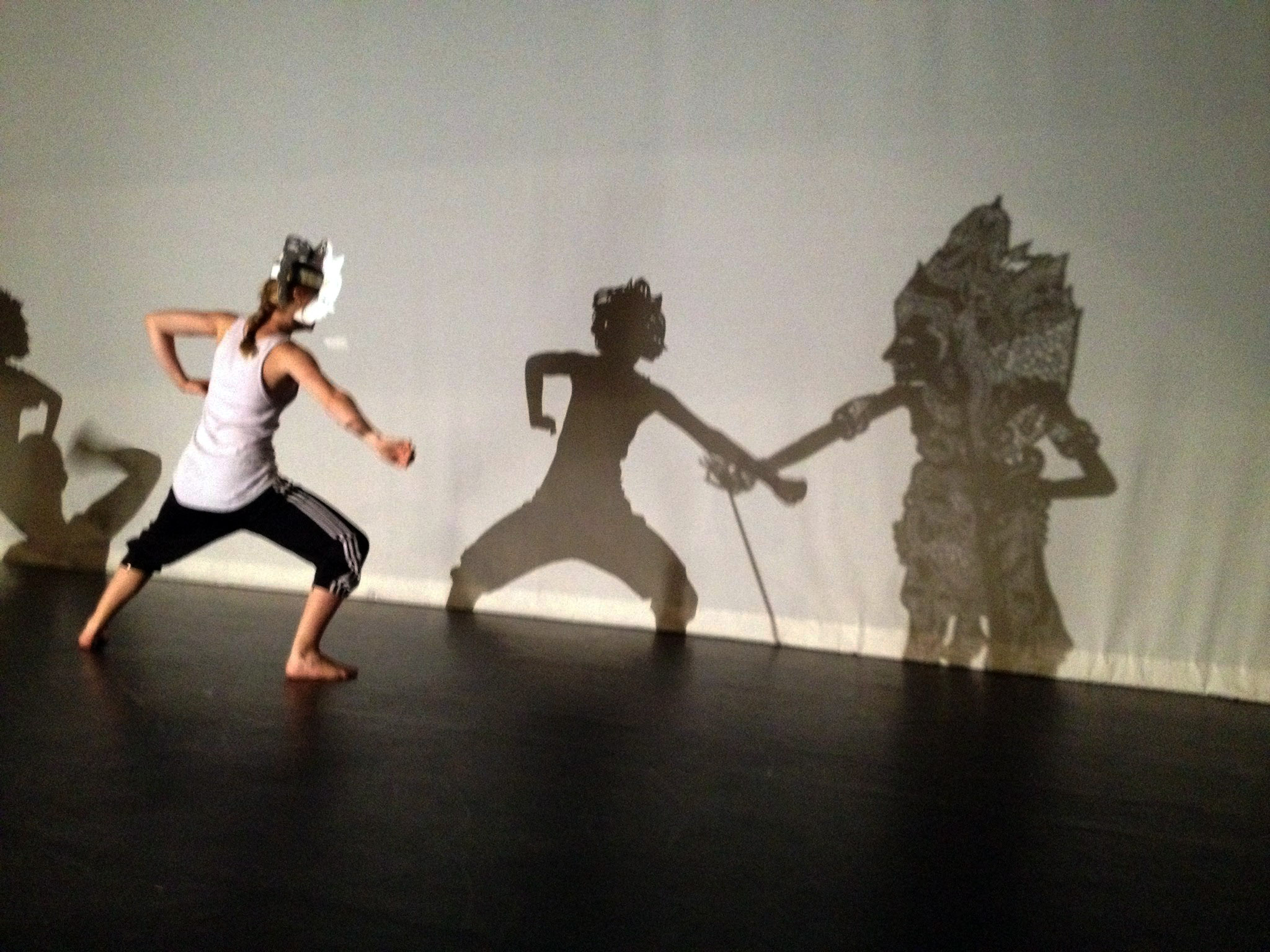
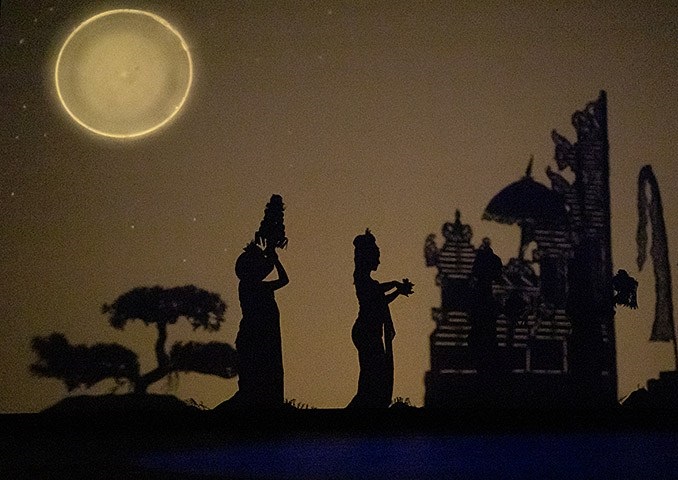
Well-known dalang, like I Ketut Kodi and I Madé Sidia, along with filmmaker-puppeteer and artistic director of ShadowLight Productions Larry Reed have experimented with this new media for wayang. Both Reed and Sidia’s contributions have made the form into what it is today, combining large screens, paintings, film, complex lighting, 3-dimensional effects, and dancers as well as shadow actors wearing masks carved in a similar manner as traditional wayang kulit puppets.
Subali-Sugriwa: Battle of the Monkey Kings (2016), for example, is new script composed by guest artist I Ketut Wirtawan, who drew upon many years of experience as a traditional wayang kulit puppeteer and dancer. In this production of wayang listrik, the main characters, Subali and Sugriwa, appeared in three forms: as traditional wayang kulit puppets, as actors in shadow masks, and as actor-dancers in half-masks in front of the screen.

Music
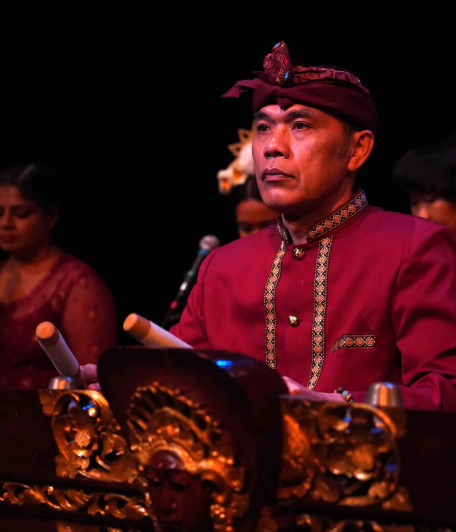
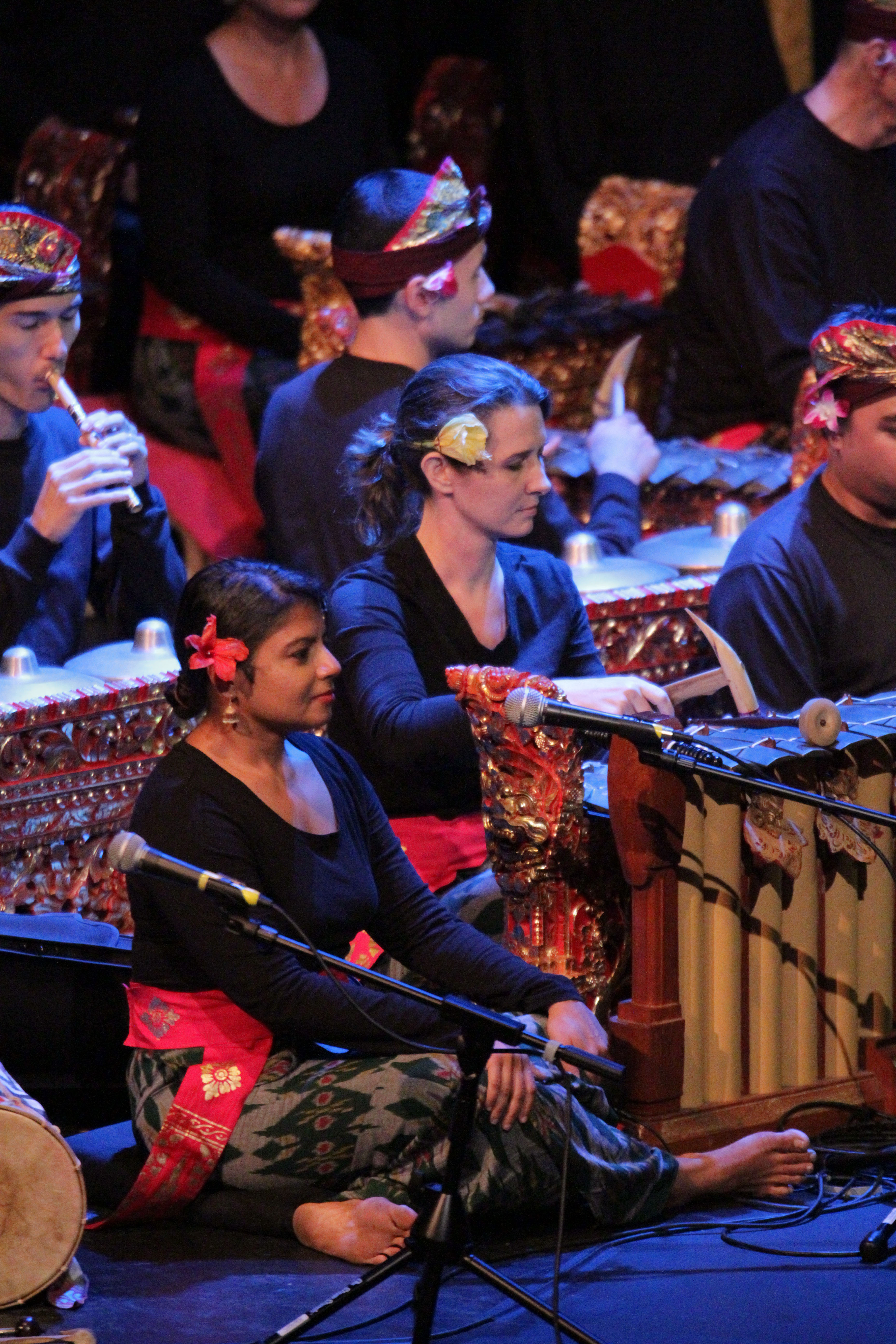
Gamelan is the name of the traditional music ensemble found in Indonesia, primarily on the islands of Java and Bali. The Balinese gamelan is comprised of metallophones, hanging gongs, double-headed drums, and other melodic instruments, including bamboo flutes, a bowed instrument, and voice. The full ensemble requires 20-30 musicians.
Traditionally, the music of the gamelan is not notated, so musicians learn by ear through repetition. The ensemble is led by the rhythmic cues of the drummer, and does not have a conductor like a Western orchestra. So, perhaps most important is the concept of teamwork – gamelan is a group effort, both in terms of the socialization of its practice and the actual physical creation of sound and is therefore a wonderful tool for learning. A perceived melody or rhythm to the audience can in fact be produced by all twenty or so musicians – every part is important. Almost every instrument is part of a pair, played by two different people, tuned to slightly different frequencies to create the characteristic ngumbang-ngisep or shimmering sound of gamelan due to sound wave interference.
The rich sound of gamelan melodies and rhythms also comes from the concept of kotekan, which is when two interlocking melodies, played by two different people, create one rich melody and rhythm. When multiple kotekan patterns are built into a particular composition, we have what truly is an ensemble. This means that it is critical that rehearsals are fully attended, and overzealous individualistic personalities rarely make it very far in an ensemble.
Gamelan Segara Madu
“The Balinese Gamelan, Segara Madu, was gifted to the university [University of Hawaiʻi at Mānoa] by the governor of Bali in the early 1990s, following a tour of Indonesian arts. The Balinese Ensemble had a number of visiting artists, directors, and most recently, Made Widana, who’s now living in Hawai‘i and has been teaching the Balinese Gamelan.”
Gamelan Segara Madu, which translates to “Sea of Honey”, is the University of Hawai’i’s Balinese Gamelan Ensemble. In 1995, the former Governor of Bali, Ida Bagus Oka, presented a complete set of Balinese gamelan gong kebyar instruments to the University of Hawai’i at Mānoa. In the years since, the ensemble has been directed by many distinguished artists from Bali. Since 2009, Gamelan Segara Madu has been led by resident artist I Madé Widana and Annie Reynolds.

Dance
Balinese dance is characterized by precise movements, both slow and sudden, as well as bold and refined. Dances are performed as offerings to the spirit world. Sometimes a dance is a re-enactment of a scene from a story. Sometimes they are not stories, but character sketches. The movements themselves are abstract and generally do not literally “act out” the actions in a story, nor do they simply mime the mannerisms of the character.
Much of the movement phrases are abstract interpretations of the natural and social environment. For example, one movement in Balinese dance called nyegut is used during key moments of faster tempo during which the eyes dart to the side, center, down, and center again, repeatedly. This is inspired by the veins of a leaf – the straight line of the main vein down the middle and the tributary veins coming off of the main vein going sideways. When the dancer does this move in the legong dance, however, she is not trying to portray a leaf; instead, she is embodying the heightened energy in the music that changed suddenly from slow to fast. The leaf is simply an inspiration. This is what is meant by abstraction. Another dance phrase is inspired by how a gecko scuttles away on water called lasan megat yeh, which translates into the dancer moving side-to-side, isolating her neck and shaking her head while her arms cross her body over her chest, and her feet tiptoe while shuffling sideways.
In Bali, it is common and accepted practice to incorporate both modern and traditional elements in creating new work. Subali-Sugriwa: Battle of the Monkey Kings, for example, utilized newly composed music, traditional dances and movement vocabulary, new choreographies, as well as original arrangements of traditional music and melodies. This production featured five fully choreographed dances interspersed throughout the performance: the Kayonan (Tree of Life) Dance, Bidadari (Angel) Dance, Raksasa (Ogre) Dance, Monyet (Monkey) Dance, and Gabor (Welcome) Dance.
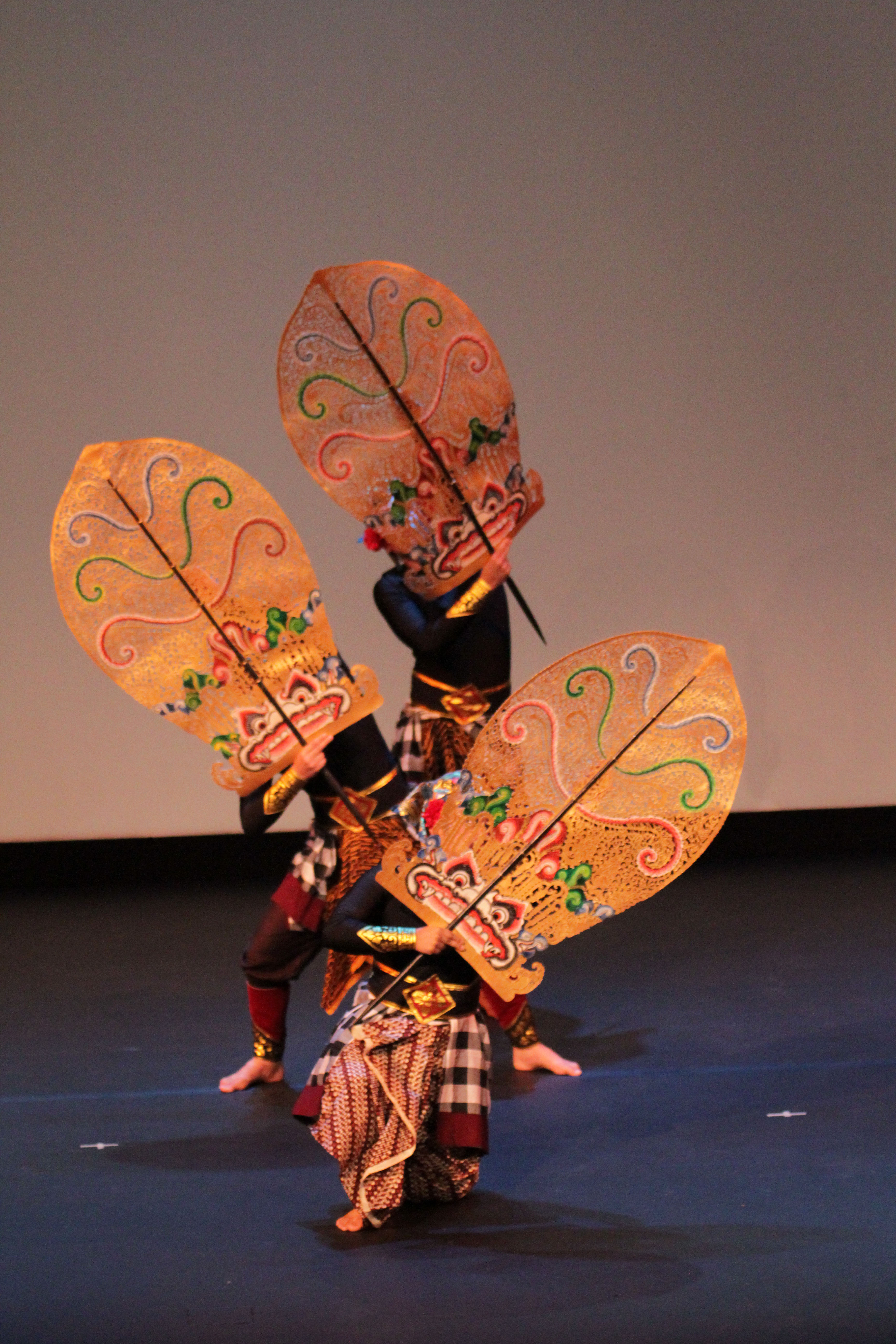
In all wayang performances, the kayonan dance always precedes the drama. The kayonan symbolizes creation and its associated elements: earth, air, fire, water, and ether. It marks the intersection of the divine and human worlds, and also the meeting of past, present, and future, as the ancient stories are retold and continue to have moral relevance in present day life.
Here, the kayonan dance from the wayang tradition has been transposed into a dance for three performers holding large custom-made kayonan. Their movements depict the power of creation and the elements of air, fire, and water.
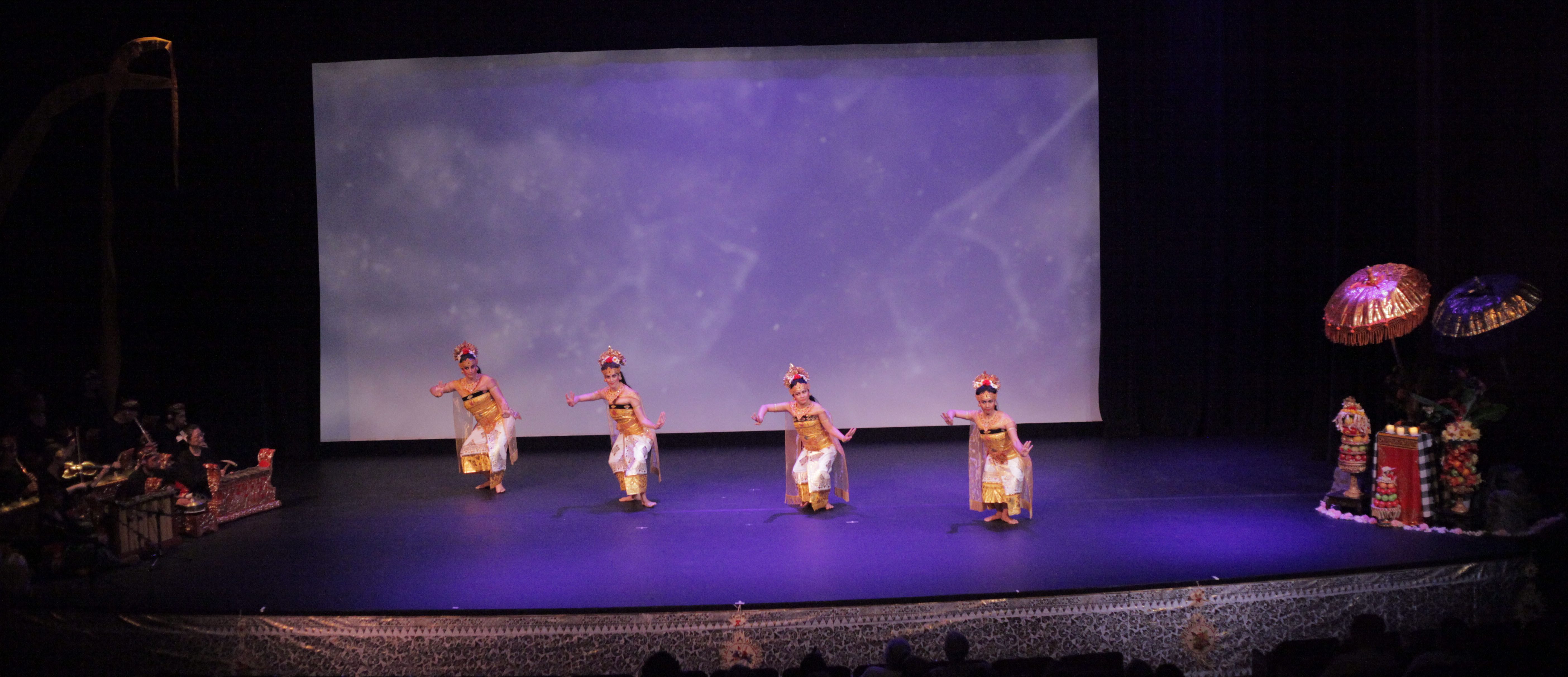
Bidadari: dance of the heavenly nymphs

Monyet: monkey dance

Gabor: court welcome dance
 Balinese Wayang Listrik at the University of Hawaiʻi at Mānoa